
Kajabi vs other platforms - what practitioners actually need to know
Jul 13, 2026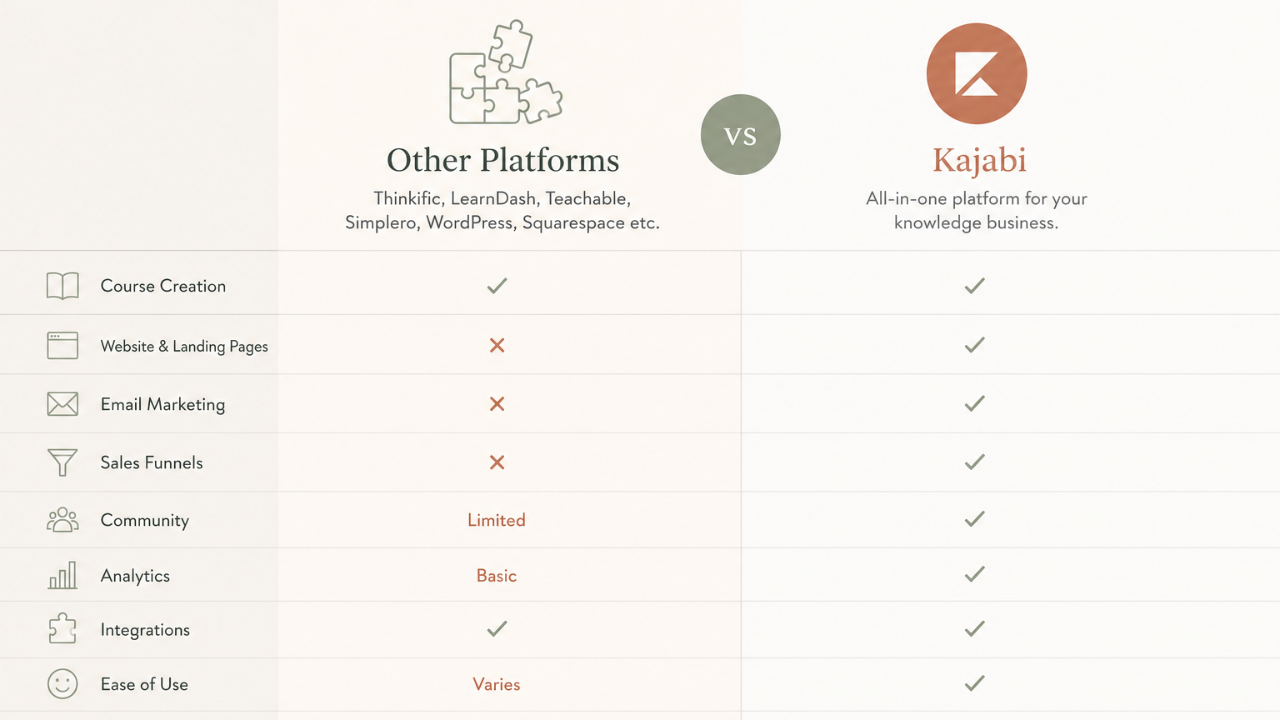
If you are a therapist, coach, or practitioner trying to decide where to build your online presence, you have almost certainly come across more platform options than feels reasonable. Kajabi, WordPress, Squarespace, Teachable, Podia, Thinkific... the list goes on, and most comparison articles online are written by affiliates with an obvious bias. So here is an honest one, from someone who has built on Kajabi since 2014 and worked across other platforms too. I will tell you where Kajabi genuinely wins, and where, in fairness, it does not.
Kajabi vs WordPress and LearnDash
WordPress with a learning management plugin like LearnDash is probably the most common alternative practitioners consider, usually because it is widely recommended and can be set up relatively cheaply.
Where WordPress wins: if you need extremely specific, highly customised functionality that falls outside what an all-in-one platform offers, WordPress's open architecture gives you near-limitless flexibility. If you already have deep web development skills or a developer on retainer, that flexibility can be a genuine advantage.
Where Kajabi wins: for almost everyone else. WordPress requires you to manage hosting, security, plugin updates, and compatibility between multiple tools that were never designed to work together. When something breaks, and eventually something always breaks, you are either troubleshooting it yourself or paying someone else to. For a practitioner who wants to build courses, memberships, and a website without becoming an unpaid IT technician, Kajabi's all-in-one structure removes an enormous amount of risk and ongoing maintenance.
Kajabi vs Squarespace
Where Squarespace wins: Squarespace is genuinely excellent for beautiful, design-led websites, and it is more affordable than Kajabi if all you need is a website with no courses, memberships, or email marketing automation. If your work is entirely 1:1 and you simply need a polished online presence, Squarespace can do that job well and cheaply.
Where Kajabi wins: the moment you want to sell a course, run a membership, or build serious email marketing automation, Squarespace requires third-party integrations to do what Kajabi does natively. Those integrations work, but they add cost, complexity, and points of potential failure. If there is any chance you will want to build digital products in the next year or two, starting on Kajabi avoids a migration headache later.
Kajabi vs Teachable, Podia, and Thinkific
Where they win: these platforms are course-specific, generally cheaper than Kajabi at entry level, and can be simpler if your only goal is to host and sell a single course with minimal additional functionality.
Where Kajabi wins: these platforms are narrower in scope. They handle the course hosting well, but your website, your email marketing, your funnels, and your broader business infrastructure typically still need to live elsewhere. For a practitioner who wants one coherent home for their entire online business, rather than a course bolted onto a separate website with a separate email tool, Kajabi's breadth becomes the deciding factor as the business grows beyond a single offer.
The honest bottom line
Every platform on this list can work. None of them are wrong choices in every circumstance. The real question is not which platform is objectively best. It is which platform fits the business you are actually building, and how much of your own time and energy you want to spend on technical maintenance versus on your actual work.
In my experience, the practitioners who are best served by Kajabi are the ones who:
- Want one platform handling their website, courses or memberships, email marketing, and sales pages, rather than several tools stitched together.
- Value their own time highly enough to pay a little more for a system that does not require constant technical troubleshooting.
- Are building, or plan to build, more than a single static course - a membership, multiple products, an evolving suite of offers over time.
- Want the option to grow without needing to migrate platforms as their business expands.
The practitioners who might genuinely be better served elsewhere are the ones with highly specific custom requirements, an existing development team, or a business that will only ever be a single simple website with no products to sell.
Why I recommend Kajabi specifically for therapists, coaches, and practitioners
Beyond the general comparison, there is a specific reason Kajabi tends to be the right fit for this particular audience. Practitioner businesses are rarely static. They evolve. A therapist who starts with a single course often adds a membership a year later. A coach who begins with 1:1 work often builds a group programme, then a self-study product, then an email newsletter audience. Kajabi is built to hold that evolution without requiring a platform change every time your business grows into something new.
If you want to see for yourself whether it is the right fit before committing to anything, you can access a 30-day free trial through my partner link - double the standard 14-day trial, with no card required to start exploring.
And if you would like a guided look at the platform, or want to talk through your specific situation before deciding, you can find out more about working with me on Kajabi here.
Curious whether Kajabi is right for you?
Try it for 30 days, free, through my partner link, and see for yourself before you commit to anything.
Author