
How to Plan an Autumn Launch in 30 Days (Without Rushing It)
Sep 01, 2026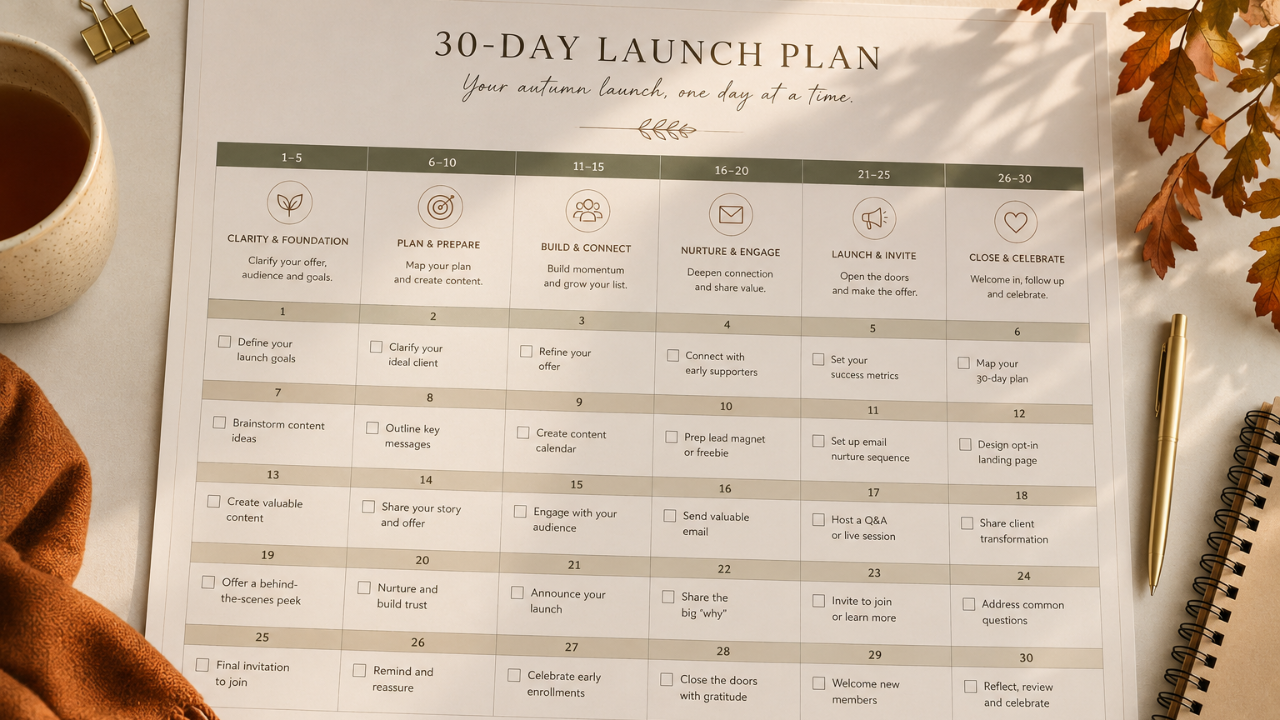
September has a particular kind of energy, doesn't it? There's something about the shift in light, the cooler mornings, the collective sense of a fresh start that makes it one of the best natural windows for launching something new.
If you've been sitting on an idea, a course, a programme, a membership, or a new offer, and wondering whether autumn might be the right time, the answer is often yes. But only if the launch is planned rather than scrambled, and there's an important difference between the two.
Here's how to take 30 days and turn them into a launch that feels calm, intentional, and genuinely like you.
Week one: Get clear before you get busy
The most common launch mistake I see among practitioners is jumping straight into content creation before the foundations are in place. You end up writing emails for an offer that isn't quite defined yet, pointing people toward a page that isn't quite ready, and feeling vaguely scattered throughout.
Week one is thinking time. Answer these questions before you touch a single piece of content:
What exactly are you launching? Be specific. Not just "a programme" but its title, its duration, what it includes, what it costs, and who it's genuinely for.
Who is it for? Not everyone. One person, described in enough detail that you could pick them out in a room. What are they struggling with right now? What do they want instead?
What's the simplest possible version of this launch? Practitioner launches don't need to be elaborate productions. An email sequence, a sales page, and a way to take payment is genuinely enough to start.
Week two: Build what needs building
With clarity in place, week two is where the practical work happens. If you're using Kajabi, this is the week to get your offer set up, your sales or landing page drafted, and your checkout working correctly. Test it yourself before anyone else sees it.
This is also the week to write the core emails: the announcement email to your existing list, the follow-up for people who clicked but didn't buy, and a closing email for the final day or two of the launch window. Three or four emails is plenty for most practitioners launching to a warm list.
Keep the copy warm and direct. Your existing contacts already know and trust you; they don't need to be dazzled. They need to understand clearly what you're offering, why it might be right for them, and how to say yes.
Week three: Show up and seed it
A launch doesn't happen on the day you send the announcement email. It happens in the week or two before, through the content you share, the conversations you have, and the way you show up in your existing spaces.
This isn't about manufacturing hype. It's about talking openly and naturally about the thing you're building, why you built it, and who you built it for. A LinkedIn post about the problem your offer solves. A newsletter that explores the theme from a different angle. A story about a client who would benefit, with appropriate anonymity.
This kind of seeding means that by the time your launch email lands, your audience isn't seeing it cold. They've been hearing you talk about this for a week or two already. The announcement feels like a natural next step, not a surprise.
Week four: Launch, follow up, close
The actual launch window for most practitioner offers doesn't need to be longer than five to seven days. Long enough for people to see your emails, think it over, and make a decision. Short enough to create a genuine reason to act rather than defer.
Send your announcement on day one. Follow up with value, a case study, an FAQ, an extended story, on day three or four. Close on the final day with a clear, warm reminder that the window is closing.
Then close it. A launch that stays open indefinitely trains your audience that there's no reason to act now. A genuine end date, respected consistently, builds the kind of trust that makes future launches easier.
A word on the pace
Thirty days sounds tight, and it is, if you're trying to build something complicated. It's genuinely achievable if you're willing to launch something simple and iterate from there.
The practitioners who get stuck in perpetual pre-launch limbo are usually the ones waiting until everything is perfect. A clean, simple launch of a well-defined offer will always outperform a polished launch of something that never quite gets off the ground.
If you'd like help mapping out your autumn launch, a 1:1 mentoring session is a good place to start. We can work through your offer, your plan, and the specific Kajabi setup you need, so you leave with a clear path forward rather than a longer to-do list. Get in touch here if that sounds useful.
Or if you're at an earlier stage and just want to explore the possibilities, Start Here: Welcome Home inside The Nest is a quiet place to begin.
Frequently Asked Questions
How long does it take to plan and launch an online offer? With a clear offer and an existing audience, a simple launch can be planned and executed in 30 days. The key is defining the offer fully in week one, building the practical elements in week two, seeding it in week three, and running the actual launch window in week four.
Do I need a large audience to launch successfully? No. A focused, warm audience of a few hundred people is often more than enough for a successful first launch of a new offer. What matters is clarity of message and relevance to the people you're speaking to, not the size of the list.
What does a Kajabi launch setup include? A basic Kajabi launch setup includes an offer page or sales page, a checkout connected to your payment processor, a confirmation email, and an email sequence for the launch. More complex launches may include a webinar, a lead magnet funnel, or an affiliate setup, but these aren't necessary for a first launch.
Can I get help planning my autumn launch? Yes. A 90-minute 1:1 Kajabi mentoring session can help you map your offer, plan your launch sequence, and get the technical setup in place. Get in touch via the Work With Me page to find out more.
Author